CDE, a leader in the design and engineering of sand and aggregate wet processing solutions for the waste recycling and natural minerals processing sectors, will showcase its SmartTech plant management app at Hillhead and demonstrate how real-time Overall Equipment Effectiveness (OEE) data is driving consistent tonnes per hour, every hour for customers.
CDE SmartTech enables customers to understand their plant’s performance, schedule maintenance and easily order parts. It equips operators, managers and owners with real-time data and insights to facilitate informed decision-making that can increase productivity, improve operational efficiency and maximise up-time.
Chris McKeown, Director of Customer Solutions at CDE, said: “This technology is all about ensuring our customers are achieving their target tonnes per hour, every hour. It’s not about the best performing hour that day, but how plant performance is monitored and optimised in real time to sustainably maintain that tonnage over the long term: per day, per week and per year. This is where return on investment is made.”
Sensors fitted to a plant provide up to 300 precise data points and continuously stream real-time, in-depth performance reports. Providing a full and transparent overview of the health of a plant, this live feed is accessible 24/7 to customers through a handy mobile app, and CDE also has dedicated staff remotely monitoring OEE data to identify trends, provide proactive maintenance and advise on plant optimisation.
TOP FOR TECH: Fife Silica, a subsidiary of Scottish building materials producer Paterson Quarries, had CDE SmartTech integrated in its new silica sand wash plant
Norman Kane, Head of Global Support at CDE, says: “We’re able to respond in a very agile way, analysing data in the moment to improve results for our customers. With SmartTech we can identify irregularities and intervene before a major downtime event occurs.
In February this year, one of our customers who operates a 375 tonnes per hour plant, 24 hours per day, 7 days a week, achieved this throughput for 92% of their total operating hours. This is just one example of the consistent high performance that we’re able to monitor through this innovative technology.”
Available globally, CDE SmartTech can be installed in new equipment or retrofitted to an existing wash plant.
Fife Silica, a subsidiary of Scottish building materials producer Paterson Quarries, had CDE SmartTech integrated in its new silica sand wash plant when it was commissioned in March 2024. After seeing the benefits, the business invested in having SmartTech retrofitted to an existing C&D waste recycling plant.
Managing Director, Tom Paterson says: “The data and insights we are getting from this technology are invaluable. Once we saw this in action on our silica plant it was a foregone conclusion that we’d move to retrofit our existing plant. It’s great to see CDE SmartTech up and running across both of our sites and we’re looking forward to seeing the impact over the coming years.”
For more information about CDE and its wet processing solutions, visit CDE at Hillhead, where the team is located at stand A11, close to the registration pavilion. You can also request a meeting with the team via the CDE website: cdegroup.com/hillhead
BUILDING A NEW FUTURE: Murdock Builders Merchants has 26 locations across Ireland and more due to open in 2025
ONE of Ireland’s leading Builders Merchants Groups has made strategic appointments at the top of the business to further enable expansion across Ireland and to drive growth.
Murdock Builders Merchants (MBM) – owned by the Murdock family from Burren – successfully acquired Merchant brand, Brooks Timber & Building Supplies (Brooks) in August 2021 and has since invested heavily in facilities, IT systems and a revised senior leadership structure.
The Group is now making four key internal appointments to strengthen its management team and leverage the significant customer and trade experience within the two businesses.
The changes will see new Managing Directors appointed to MBM and Brooks and two appointments into new Group roles operating across both brands.
Martin Farrell, currently Commercial Director within MBM, will take the helm as Managing Director for MBM across Ireland, following over 25 years with the business. Pat Moore, an industry veteran who joined the Brooks senior executive team earlier this year, will now take the reins as Managing Director of Brooks. His role will support current Brooks’ CEO Kieran Burke for an interim period.
DREAM TEAM: Martin Farrell and Peter Kelly
James Higgins, Group CEO MBM said: “It’s an exciting time for the Group and these appointments reflect that. Bolstering the senior team with two experienced Managing Directors will further enhance our focus on customers. Martin and Pat will ensure we can successfully drive all-island growth, look to the future and make smart and informed decisions based on the combined merchanting and commercial experience of our new senior leadership team – they have unrivalled industry experience and will drive the Group focus of exemplary customer service and being of value to our customers.”
At a Group level, Peter Kelly will take up a new role of Group Finance Director, tasked with driving strategic growth through acquisition and within the existing 26 branches across NI and the ROI.
Reflecting the focus on the Key Dublin area market, Brendan Sammon, another industry veteran, will take on a new role of Group Regional Director East, responsible for building on and driving growth through the eight merchanting branches currently operating in the Greater Dublin region across both the MBM and Brooks brands.
James continued: “The Brooks’ acquisition was an important move for us as part of our ambitious growth plans. Brooks has outstanding brand recognition among our trade audience in the ROI and particularly the key Greater Dublin area. This acquisition, in conjunction with the four established Murdocks merchants in Dublin, has cemented our presence in a key trading market. The appointments of Peter and Brendan will drive collaboration across the two Brands.
With 26 locations across Ireland and more due to open in 2025, we will continue to have a focus on organic growth and further acquisitions. The four appointments draw on unrivalled industry knowledge to catapult us to the next phase of growth, driving further customer acquisition. They will allow us to combine the wealth of experience and knowledge within the merchanting businesses, to support the growth of both brands individually and support the Group’s ambitious plans as we strive to cement our place as Ireland’s leading Independent Builders Merchant group.”
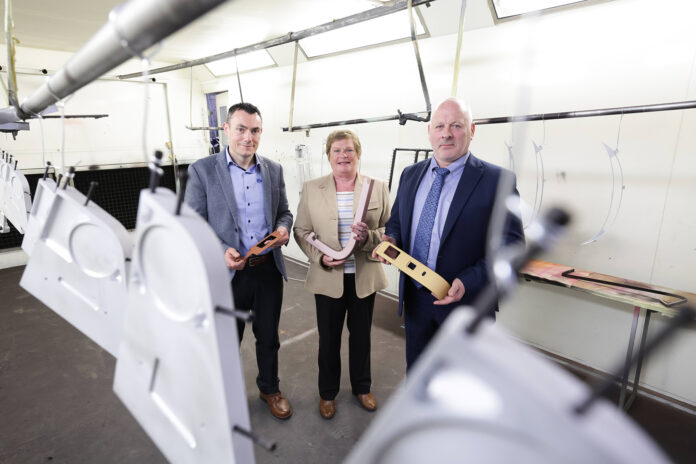
READY TO SOAR: Ronan Callan, Director of Operations, The Exact Group; Dr Vicky Kell, Director of Innovation, Research and Development at Invest Northern Ireland; Stephen Cromie, Managing Director, The Exact Group
PRECISION engineering and specialised finishing company, The Exact Group has joined a network of certified applicators of Cerakote, the highest performing world-leading ceramic coating, following a £300k investment, which will further elevate the company’s capabilities within the aerospace sector.
The successful bid for this accreditation is the result of four years’ work within the company, assisted by Invest Northern Ireland and Innovate UK, and investment in research and development (R&D), innovative technology and new machinery. The investment has enabled The Exact Group to develop specialist skills that will ensure it can meet the rigorous cosmetic, volume, regulatory and testing requirements of its growing aerospace customer base.
A specialised cleanroom environment for the Cerakote application process has been created at the company’s facility in Newry, and its significantly expanded composites department now houses a dedicated state-of-the-art finishing suite and five paint ovens for the preparation and finishing of all Cerakote products.
A versatile specialised protective thin film, Cerakote is revolutionising many sectors globally, particularly aerospace, due to its robustness and ability to be applied to a variety of surfaces including metals, alloys, polymers, composites, wood and plastic, making it an ideal treatment choice for many companies.
Cerakote also provides a more effective thermal barrier than other protective coatings in the market. Offering heat, chemical, abrasion and corrosion resistance, which combats the heat and shock effects experienced on aircraft, it is renowned for its durability and flexibility. The use of the coating is more cost and time effective, and also reduces the finished weight of the composite.
The product incorporates anti-microbial properties, which provide an extra layer of protection against pathogens and contribute to passenger safety, whilst minimising infection control, making it an ideal choice for the aerospace sector.
The Exact Group offers a range of service across sectors including automotive, electrical, energy, marine, MedTech and transport, but specialises in providing a rapid response service to the aircraft interiors industry, and is a supplier of choice for many of the leading global tier one companies.
SPECIALIST SKILLS: Ronan Callan, Director of Operations, The Exact Group and Stephen Cromie, Managing Director, The Exact Group
Ronan Callan, The Exact Group’s Director of Operations commented, “This latest development demonstrates our commitment to constantly evolving our products to anticipate and meet each customer’s unique requirements. Our new accredited status and the completion of training with Cerakote will significantly expand our customer base, while enhancing our reputation as a technical expert in delivering complex and highly specialised services to the aerospace sector.
“The Exact Group offers more than just the application process of Cerakote – we are utilising our extensive engineering expertise and technical knowledge, in addition to the whole package of traceability, FAI and conformity and that’s something that has been largely welcomed by our global customer base.”
Nemo Reeve, Development Manager at Cerakote UK said, “We are delighted to welcome The Exact Group to our Certified Cerakote Applicator Network, following completion of the training programme by the company’s skilled painters at its facility in Newry, Northern Ireland. The Exact Group’s technical knowledge and engineering expertise allows the company to optimise application techniques and adjust skill sets to really get the best out of Cerakote.”
Dr Vicky Kell, Director of Innovation, Research and Development at Invest Northern Ireland spoke about The Exact Group’s newest service saying, “The Exact Group recognises the value of investing in innovation and R&D to remain competitive and continue to grow its business outside Northern Ireland.
“With our support, its investment in R&D has resulted in it developing pioneering film coating which has led to its success with Cerakote. This new service is now set to open the door to many new opportunities, sales and customers for the company. We will continue to work with The Exact Group to ensure it has the right tools to push the boundaries of innovation, maintain its competitive edge and continue its growth.”
Ronan continues, “The introduction of Cerakote to The Exact Group’s offering gave our customers a superior solution for coating different types of materials, and enabling protection from the elements; we quickly realised that it is a fantastic product that outperforms many other solutions. We are confident that it will help us revolutionise the sectors that we work in and allow us to continue to innovate and collaborate with other industry leaders.”
The Exact Group is committed to the highest standards of quality and excellence and currently holds the EFQM 5 Star and SC21 Silver awards, in addition to the ISO 9001 and AS9100 standards.
LOCKED AND LOADED: ASSA ABLOY to form a new global division
ASSA ABLOY Door Group is proud to announce a new internal restructure that sees the company joining forces with all comparable business units across Europe, the Middle East, India and Africa, to form a new global division – the ASSA ABLOY EMEIA Door Business Segment.
This new alliance between all door business segments across the different regions strengthens the company’s offering and will help focus on key objectives, as well as further cementing Door Group’s lead position in the marketplace.
As part of the partnership, Door Group will benefit from a range of innovative new products, which are set to be unveiled in the coming months.
GROUND-BREAKING PRODUCTS: Brian Sofley, Managing Director of Door Group
Brian Sofley, Managing Director of Door Group, said: “We are delighted to now be part of the ASSA ABLOY EMEIA Door Business Segment, and are excited about the new opportunities this union will offer us.
“One of the advantages we are keen to promote is the potential for us to tap into a wealth of ground-breaking products already available in other regions and bring them to the market in the UK and Ireland.
“Our customers rely on us to provide complete solutions tailored to their requirements, and we have dedicated ourselves to being a trusted partner at all stages of the door lifecycle – from initial specification right through to installation, service, maintenance and beyond.
“The ability to collaborate with other divisions within the ASSA ABLOY EMEIA Door Business Segment will not only help us serve our customers more effectively but also strengthen our brand and unique position in the marketplace.”
To learn more about ASSA ABLOY Door Group and the range of products and services it provides, go to https://www.assaabloy.com/uk/en.
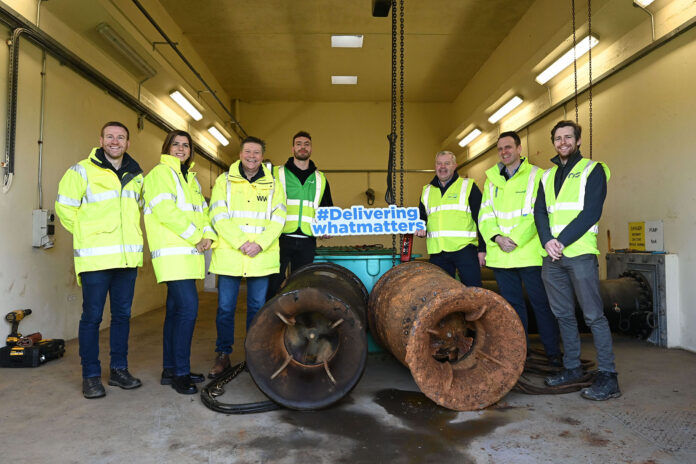
OUT WIHT THE OLD, IN WITH THE NEW: Portaferry Road team with old & new pumps, Matthew Lundy, Tzvetelina Bogoina, Mark Mitchell (all NI Water), Charles Purce GRAHAM, Peter Ferguson NI Water, David Slevin (GRAHAM) and Aaron Magerr (RPS).
NI Water has marked the halfway mark in its Price Control (PC) 21 programme of base maintenance work with the completion of a £16m investment in its portfolio of wastewater pumping stations (WwPS).
Commenting on this recent milestone, Tzvetelina Bogoina, NI Water Director of Infrastructure said: “NI Water deals with over 370 million litres of wastewater every day – that’s roughly the same volume as four and a half million household baths – and we rely on 1,300 wastewater pumping stations to ensure that this wastewater gets to our treatment works so that it can be properly treated and returned safely to the environment.
“Maintaining our pumping stations and ensuring that they can work as efficiently and effectively as possible is critical to keeping our wastewater network flowing and protecting the environment.
MAJOR INVESTMENT: NI Water’s Wastewater Pumping Station (WwPS) base maintenance team from NI Water, McAdam, RPS, BSG and GRAHAM pictured at Portaferry Road WwPS in Newtownards, where a £324,000 upgrade has been completed as part of the overall £16m programme of investment in the last three years
“As we reach the halfway point in our current price control (PC21) period, NI Water is pleased to acknowledge the important roles that our colleagues and local supply chain play in successfully delivering the wastewater pumping stations base maintenance programme across the four regions – north, south, east and west – of Northern Ireland.
“Collaboration and engagement with these key stakeholders as well as our operational colleagues is central to planning the base maintenance work and ensuring that our equal regional spend is invested where improvements are most needed.
“This means that we are continually working with our appointed consultants and contractors from McAdam, RPS, BSG and GRAHAM to instil innovation and drive efficiency to get the best performance out of our existing wastewater pumping station assets.
“Carrying out carefully planned base maintenance work in both our water and wastewater networks is fundamental to NI Water meeting important environmental objectives and maintaining services for all our customers in Northern Ireland.
“We also rely on the public to play their part in helping to keep our wastewater network flowing by only flushing the 3 Ps – pee, poo and paper. Anything else should be bagged and binned to ensure all the wastewater pipes and pumps remain blockage-free.”
MODULAR and portable building supplier GCS Cabins provided the Sutton Sea Cadets with additional training facilities. GCS Cabins delivered and installed a jackleg cabin adjacent to the Sea Cadets’ existing building in the London Borough of Sutton.
Sea Cadet Corps (SCC) is a nationwide charity youth organisation open to all young people aged 9-18. SSC promotes the development of young people to achieve their physical, intellectual and social potential through nautical-themed activities based on the customs and traditions of the Royal Navy.
Training activities include learning to sail, catering for a crew, marine engineering, first aid and playing in the Sea Cadet Band. Activities are led by friendly leaders who build confidence and resourcefulness in the cadets, helping them become well-prepared to take on life’s challenges.
The Sutton Sea Cadets is a self-funded organisation keen to offer more training facilities to young people in their area. To create additional training space, GCS Cabins provided several building options, including a jack-leg cabin that was perfect for the Sutton Sea Cadets’ needs and within budget.
Jade Sheppard, Senior Account Manager at Long Eaton-based GCS Cabins, said: “After the customer selected the building, we arranged a site visit to assess delivery challenges and devise a plan. Careful measurement dictated that an 8-wheel rigid HIAB could pass through the restricted access. We also arranged for the removal of the grass verge, this freed up the site for the new building.”
Sutton Sea Cadets now have a brand-new training space to educate the cadets in a range of activities. The space is finished in an external colour chosen by them to reflect their branding.
Ron Smith from Sutton Sea Cadets said: “From the offset, GCS demonstrated an understanding that we needed to explore our options to ensure we secured the best option to meet the needs of our new RMCD, not only including which cabin, but value for the funds we had available and, for us, the challenges of the delivery to a difficult site. While working in collaboration with GCS, they demonstrated a high level of professionalism, support, patience, and a full understanding of what we were looking to achieve.”
GCS Cabins is a modular building provider based in Long Eaton but working nationwide. They are experienced in creating inspiring learning and recreational spaces that help youth charity groups support their members.
AWARD WINNERS: RENOLIT ALKORPLAN roofing products working on the development of the new Gradel Quadrangles at Oxford University’s New College
RENOLIT ALKORPLAN roofing products has received the prestigious Single Ply Roofing Association (SPRA) Award 2024 for ‘Best Detailing’ for its contribution to the development of the new Gradel Quadrangles at Oxford University’s New College, leveraging the innovative use of Augmented Reality (AR) and Artificial Intelligence (AI) to enhance project outcomes.
The prize was awarded during the traditional SPRA Awards Luncheon that took place at the Macdonald Burlington Hotel of Birmingham on June 6.
The Single Ply Roofing Association (SPRA) represents the UK’s single-ply roofing industry and is dedicated to promoting growth, sustainability, and high standards within the sector.
These are values that RENOLIT ALKORPLAN roofing products share and embody through innovative solutions that promote building efficiency and concrete actions for environmental sustainability.
“Receiving the SPRA Award for ‘Best Detailing’ is a remarkable honour that reflects our dedication to sustainable innovation and quality in roofing solutions. This project is a testament to what can be achieved when industry leaders come together to challenge the status quo and push for a more sustainable future. We are proud to be part of the SPRA community, working alongside peers who share our commitment to excellence and environmental responsibility”, says Keith Steele, National Sales Manager of RENOLIT ALKORPLAN roofing products.
SUSTAINABLE SOLUTION: RENOLIT ALKORPLAN used Building Information Modelling (BIM) technology for precise material quantification and whole life carbon assessments
The Gradel Quadrangles project stands as an ambitious new development, featuring a three-storey quadrangle-style building that includes student accommodation, educational facilities, a porter’s lodge, and a landmark 21.5m tower. A key focus of the project was to align with New College’s objective of reaching net zero carbon by 2035, prompting a re-evaluation of the initial sprayed concrete roof design in favour of a more sustainable solution.
Through a collaborative effort with David Kohn Architects and structural engineers, the project embraced innovative approaches such as utilising Building Information Modelling (BIM) technology for precise material quantification and whole life carbon assessments. The team also leveraged Environmental Product Declarations (EPDs) for significant carbon savings and employed the tracker+ carbon capture tool for comprehensive sustainability data management from the supply chain. The works were carried on by Sir Robert McAlpine.
For the critical task of waterproofing, RENOLIT ALKORPLAN Alkorplan F membrane was selected, paired with the innovative RENOLIT ALKORPLAN Solar mount system to secure the bespoke tiles.
The execution of the Gradel Quadrangles project required meticulous planning and innovative techniques, such as AR and AI, to meet the ambitious sustainability goals set by New College.
RENOLIT ALKORPLAN roofing products took on the challenge of waterproofing this complex structure with a keen focus on both durability and aesthetic appeal. The project began with the installation of a single ply membrane, underpinned by the RENOLIT ALKORPLAN Solar bar, guaranteeing a robust 20-year warranty.
BEST BAR NONE: RENOLIT ALKORPLAN installing the Solar bar, with its position carefully calculated by engineers using Augmented Reality (AR) software
The roof’s intricate geometry required the application of three layers of insulation, starting with a 105mm thick base layer, followed by two subsequent layers of 60mm. This strategic reduction in the thickness of the second and third layers was crucial for achieving the stunning rolling curves and free-flowing design of the roof.
Once the waterproofing was securely in place, the team embarked on setting out and installing the RENOLIT ALKORPLAN Solar bar, with its position meticulously calculated by engineers using Augmented Reality (AR) software.
This advanced technology modelled a net, employing an AI algorithm to precisely calculate the placement of each of the 4,000 tiles required for the roof. Utilising the AR software on mobile phones enabled the team to model all tiles, the Solar bar, and the top hat, facilitating the filtering through layers to pinpoint exact locations within the project.
Ensuring each tile was oriented correctly was paramount, as this precision allowed them to seamlessly nestle together, forming a perfect, free-flowing roof, and provided the bond that fortified the tiles’ strength. With 8,000 plates meticulously set out and affixed, the subsequent step involved thermally welding the RENOLIT ALKORPLAN roofing products’ F membrane to the plate.
This welding bond was essential, offering the adhesion needed to support the RENOLIT ALKORPLAN Solar bar, which in turn, supported a top hat and ultimately the tile. This structure ensured that, even under wind suction loading, the integrity of the roof would remain intact, all the way back to the substrate.
The PVC-P profile forms the base of the system. Hot air welding is used to fuse the RENOLIT ALKORPLAN Solar profile to the roofing membrane for a fully integrated finish. The profile is securely fixed in place and cannot move and is therefore able to host creative finishings such as in the Oxford University. This is without the slightest risk of penetrating the waterproofing membrane!
The project was adorned with 3mm anodized aluminium polygonal-shaped tiles in a light bronze colour, accentuating the building’s stone features and contributing to the overall aesthetic excellence.
Transitioning from a concrete design to a glulam timber structure with tessellated aluminium tiles not only achieved the desired modern aesthetic but also offered a cost-effective, sustainable alternative. This strategic choice reduced embodied carbon, decreased construction time by three months, and garnered recognition from the Institute of Civil Engineers (ICE) Carbon Champion programme.
The project has been praised as “striking and ambitious” by the Oxford Design Review panel and described as “unusual, quite unlike anything currently in Oxford” by Historic England, underscoring its unique contribution to the architectural landscape, earning it the SPRA Award 2024 for “Best Detailing”.
GOOD LORDS: Marylebone Cricket Club has named GRAHAM as the preferred bidder to undertake the redevelopment of Lord’s Cricket Ground
LORD’S Cricket Ground, the iconic home of cricket, is set to undergo a transformative redevelopment project encompassing the Tavern and Allen Stands.
Marylebone Cricket Club (MCC) has named GRAHAM as the preferred bidder to undertake the project, which aims to enhance spectator experience, increase capacity, and modernise facilities while preserving the rich heritage of the Ground.
Aligned with MCC’s vision, the project encompasses several key objectives. These include increasing spectator capacity to reinforce Lord’s status as Britain’s premier cricket venue, maximising year-round revenue from the stands, and elevating architectural standards. Additionally, the project seeks to positively impact the St John’s Wood streetscape.
Throughout the redevelopment, Lord’s Cricket Ground will remain fully operational, ensuring minimal disruption and continued spectator access during the 2025 and 2026 seasons. The project involves extensive repurposing of the Tavern Stand while retaining its iconic features, alongside the demolition and modern reconstruction of the Allen Stand to integrate fully accessible, contemporary Members’ and public spectator amenities.
Among the enhancements, the project will add at least 1,100 additional seats, improving the viewing experience for spectators. Furthermore, it will include the construction of a new pitch-facing hospitality restaurant and suites, offering premium amenities such as food and beverage services, to deliver an enhanced matchday experience for visitors.
HOZAT: Marylebone Cricket Club has named GRAHAM as the preferred bidder to undertake the redevelopment of Lord’s Cricket Ground
Robert Ebdon, MCC Estates Director, said: “The redevelopment of the Tavern and Allen stands will complete our stand development programme, in which we have modernised facilities at Lord’s to continue to ensure the Ground remains a world-class venue for cricket. The stands will also strengthen the Club’s already-impressive sustainability credentials, and we are looking forward to the construction phase and working closely with GRAHAM.”
Rob Joyce, Development Director at GRAHAM, said: “We are thrilled to embark on this transformative project at Lord’s Cricket Ground. Our partnership with the Marylebone Cricket Club (MCC) will deliver world-class sporting infrastructure while preserving the rich heritage of this historic venue. Together, we aim to enhance the Members’ and public spectator experience, expand capacity, and usher in a new era at the iconic home of cricket. This project represents a significant milestone in our ongoing commitment to shaping vibrant, sustainable communities through exceptional construction projects.”
GRAHAM will work alongside Gardiner & Theobald, Wilkinson Eyre Architects, and Arcadis to deliver the project, with construction work scheduled to start on 30th September 2024 and complete at the end of May 2027.
TOUGH TIMES: The slump in building is having a knock-on negative impact on sales of construction vehicles
THE UK construction industry is facing a gloomy outlook for 2024, despite tentative signs that the economy is improving.
Inflation is still above the Bank of England’s target and so, for the time being, we don’t expect the Monetary Policy Committee to vote for lower rates. This is making mortgages expensive and pushing up costs for new construction projects, serving to both deter people from buying houses because of affordability constraints and to discourage companies from borrowing to build, causing both residential and non-residential construction projects to slow (although the market for repair and maintenance is performing well).
This slump in building is having a knock-on negative impact on sales of construction vehicles and we don’t foresee sales picking up until overall economic conditions improve enough to fuel new investment in construction, with activity potentially increasing by the end of this year.
The UK Economy
The UK’s Gross Domestic Product (GDP) grew by 0.6% in Q1 2024 versus the previous quarter. This was largely attributed to falling inflation rates and means more disposable income per person on average.
The Consumer Price Index including owner occupiers’ housing costs (CPIH) for the 12-month period up to April 2024 increased by 3.0% year-on-year, representing a 0.8% decrease compared with the value in March 2024. However, the CPIH annual rate for services remained at 6.0%. With much of the UK’s economy based on financial and retail services, prices are still going up compared with last year.
It is for this reason that the Bank Rate, currently sitting at 5.25%, won’t be cut anytime soon, and maybe not until later in the year. The Bank of England’s priority is to get inflation under control, and ideally as close as possible to the 2% target figure.
For the month of March 2024, UK Construction Output was valued at £15.16 billion – this was a 0.4% decrease compared with February 2024 and a 2.2% decrease compared with March of the previous year (adjusting for seasonality and price changes). In five of the past six months, construction output has decreased compared with the previous month, which paints a fairly gloomy picture.
Segmenting construction by work type (either new work or repair & maintenance) and by building type (either housing or non-housing), it can be seen in the chart below that repair & maintenance (R&M) is performing better than new work, with year-on-year growth rates of +7.3% and -8.5% respectively. In terms of housing, new housing output is down 10% year-on-year, however it is up 2.3% month-on-month. It’s likely that increased rainfall over the past couple of months is partly to blame for the fall in output.
R&M doing well doesn’t really have much of an impact on the construction equipment market – it’s newly started projects (especially housing) that require purchase or rental of equipment like excavators and other big clearing equipment. Work started on new houses in the UK fell by over 40% in Q4 2023 vs Q4 2022, from 39,040 to 23,360 houses. Looking ahead, new orders (i.e. planned projects) output grew by 16% in Q1 2024 versus Q4 2023, consisting of a decrease of 4.5% in new housing, and a 25% increase in other new work. However, as new housing is the main driving force behind the construction equipment market, 2024 is likely to see fewer sales compared with 2023.
Examining which industries have had the greatest contribution to the overall growth, it can be seen from the chart that, when comparing Q1 2024 with Q1 2023, electricity infrastructure had the greatest positive contribution (+1.91%), while private housing had the highest negative contribution (-4.14%). Other industries also seeing a decline in activity include infrastructure for roads (-1.40%) and railways (-1.35%). To increase sales performance this year, construction equipment rental companies may want to consider getting more involved in the better-performing industries, while limiting exposure to private housing and other poorly performing areas.
Left graph: New housing performing poorly, while repair & maintenance is doing quite well. Right graph: Electricity infrastructure tops growth contribution; private housing worst off. Data source: ONS
Construction Materials
Monthly deliveries of bricks data can be a useful leading indicator for the number of new houses planned to be built. Looking at the 12-month rolling average, month-on-month deliveries have decreased every month from October 2022 to March 2024 – that’s a year and a half of consecutive decline! It’s a similar story for other building materials like sand and gravel. However, the 12-month rolling average seems to suggest that brick deliveries may be starting to bottom-out. Assuming further reductions to inflation, and subsequent moves to decrease interest rates, there is a chance that house building activity may start to pick up again by the end of the year.
Like most things, construction materials have seen their fair share of price increases. Looking at the construction material price index for all types of work, there have been consecutive increases for the past three months – with prices increasing by 0.9% from December 2023 to March 2024. Prices are slightly lower now than they were at their peak in July 2022, although still considerably higher than pre-pandemic levels.
High material prices are another dampener on the construction industry, as they impact margins and the general health of businesses’ cash flows. It is one of the main reasons behind the increased insolvency rates affecting the construction industry. In March 2024, 310 construction businesses became insolvent, while in the 12-month period leading up to March 2024, this figure was 4,274 – the highest of any of the major industries in the UK. Other reasons for these startling figures include persistent labour shortages and companies taking on more business that they can handle (or are equipped to handle), leading to eventual loss of contracts. To survive in this market, operators must make choices about where to deploy capital, and may decide to hold off purchasing/renting new machinery to combat other ongoing pressures. Alternatively, operators may decide to switch from their preferred brands and purchase cheaper equipment, shifting the dynamic of the market.
Left graph: Deliveries of bricks have been declining since mid-2022. Right graph: Material prices remain high compared to pre-pandemic levels. Data source: ONS
Impact on the Construction Machinery Market
So what does this all mean for the UK construction equipment market?
Finning, a major supplier of construction equipment to rental companies and big contractors, announced a Q1 year-on-year net revenue increase of 3% in the UK and Ireland. This was driven primarily by used equipment sales (which nearly doubled), while new equipment sales remained level. It’s likely that affordability is the main reason for contractors turning to used rather than new machines. Finning’s product support revenue was down by 7% over the quarter, due to a combination of lower customer activity levels and reduced machine utilization hours. If activity is down, contractors aren’t going to buy new machines, especially if existing equipment isn’t being used to its full potential.
Ashtead Group, a large equipment rental company, had a rental-only revenue increase of 9% in the UK, of which 7% was organic. This was driven by both increased rental prices and higher sales volume, allowing the company to gain market share. When the economy is tough, companies prefer to rent/lease construction equipment rather than purchase, and if they do need to purchase used machinery costs less than new equipment.
A generally tough 2024 for the construction industry will negatively impact the number of construction vehicles sold. According to the latest edition of Interact Analysis’s Off-Highway Vehicles Market Study, the construction machinery market (in unit terms) is expected to fall by 6.6% in 2024 versus 2023, with just over 30,100 vehicles forecast to be sold (see chart below). This includes vehicle categories such as bulldozers, excavators and loaders. Beyond 2024, we anticipate a small improvement in sales, with 30,600 units projected to be sold in 2025 – a year-on-year increase of 1.6%. However, we’re not expecting sales of construction machinery to match 2023 levels until at least 2027; although 2023 was an artificially high year due to a rebound from the Covid-19 pandemic.
Current polls suggest that Labour will win the next election, which will take place on July 4 this year. The party’s manifesto commitment to boost house building could drive equipment sales in the future. However, it will take some time (possibly many years) before these plans are fully realized. Another (albeit unlikely) area where the UK could boost its construction industry is by backing construction of semiconductor manufacturing facilities in order to become more self-sufficient in this industry sector (similar to what’s happening in the US). However, the amount of investment and materials required would be substantial, making this unlikely.
SALES SLUMP: Slowdown in sales expected in 2024; hopeful for small levels of growth going forward
WINNING WAYS: Pictured at the CITB NI SkillBuild NI regional competition 2024 was winner of the Haldane Fisher Young Apprentice of the Year Luke McIlwrath who also came second in carpentry from South East Regional College with Barry Neilson OBE Chief Executive CITB NI and awards host Sarah Travers.
THE Construction Industry Training Board NI (CITB NI) annual SkillBuild NI Regional Competition 2024 in partnership with CITB (GB) and South West College, has taken place at the Technology and Skills Centre, Killyhevlin, Enniskillen.
The competition is a search for the top performers within construction apprenticeship programmes from across Northern Ireland and a showcase of the wealth of talent, professionalism, and the brightest recruits throughout the industry.
93 of the brightest recruits and top performers within construction apprenticeship programmes from across Northern Ireland competed against each other to win in categories: Brickwork, Furniture & Cabinet Making, Carpentry, Electrical Installation, Joinery, Painting & Decorating, Fire and Security, Drylining, Plastering, Plumbing, Wall & Floor Tiling.
SkillBuild is delivered by the Construction Industry Training Board (CITB GB) and showcases some of the brightest talent in construction. Supported by Department for the Economy and local construction companies, the competition provides an opportunity to showcase the high level of skills and the impressive talent within the workforce, as well as raising the status and standards of professional and technical education and training.
CHIP OFF THE OLD BLOCK: Mathew Carswell from SRC College was first for BricklayingHE’S GOT THE SKILLS: The SkillBuild Appreciation Award goes to Paddy Maguire
There were 12 first place winners in the categories with overall young apprentice of the year.
Winners from the NI Regional Competition, will have the opportunity to represent Northern Ireland in the Skillbuild UK National Finals in November.
Barry Neilson, Chief Executive CITB NI, said: “A huge congratulations to all the apprentices who took part in the SkillBuild NI Regional Competition 2024. The event displayed remarkable talent and showcased the dedication of future construction leaders. Witnessing their enthusiasm highlights a promising future for the industry. Apprenticeships are crucial for industry growth, allowing businesses to shape their future workforce and develop necessary skills. I would like to take this opportunity to thank our partners CITB (GB) and SWC for the fantastic showcase of the NI talent pool throughout the competition and we look forward to the SkillBuild UK National Finals in November.”
Celine McCartan Principal and Chief Executive said: “We were honoured to host the SkillBuild NI regional competition at our Technology and Skills Centre in Enniskillen. It’s an affirmation of our commitment to nurturing talent and providing a platform for skill development. We welcome participants to showcase their abilities and embrace the spirit of competition, knowing that it’s through such events that excellence is recognised and celebrated. The standard of work on display was exceptional and I wish all the winners every success as they progress to the next stage of the national competitions. Their success is a credit to the Further Education sector lecturers and partner employers who have been supporting them in advance of the intense competition. I would also like to thank the teams at SWC, CITB (GB) and CITB NI for their work in bringing this prestigious competition to the South West.”
For further details on SkillBuild NI and CITB NI support for apprenticeships and employers visit www.citbni.org.uk
Follow CITBNI on Facebook, X and LinkedIn #SkillBuildNI2024.